Why placemaking must be at the heart of new towns
Insight
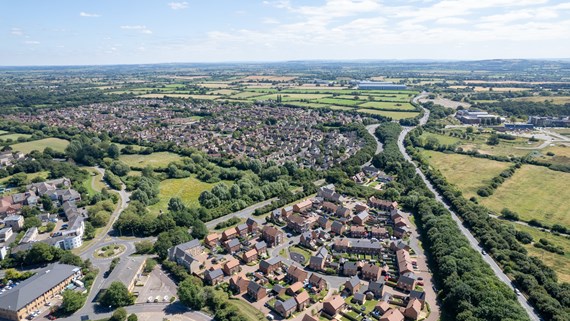
The government’s new towns programme is not simply about addressing the housing shortfall at speed; it is about creating places that support economic growth, health and community over decades. Placemaking provides just such an approach, through its focus on design quality, infrastructure, governance and stewardship – so that large-scale development can create thriving towns. These themes run throughout the New Town Taskforce’s (NTTF) report, Building New Towns for the Future (Report).
In its response to the Report, the government clearly supports the NTTF’s focus on using the principles of placemaking in delivering the new towns, but chooses its words carefully when discussing land acquisition. It states that it will expect development corporations to use compulsory purchase orders (CPOs) to acquire land for new towns where “it has not been possible to negotiate an agreement with the landowner” and that compensation for “hope value” can be disregarded where the new town provides affordable housing and it is otherwise “justified in the public interest”.
The Report recommends that private sector partnership and investors may play an important role in new town delivery, perhaps through land partnerships or joint ventures “that share risk and reward fairly between public and private interests”. However, that will only be considered “where all partners can demonstrate alignment with the relevant new town placemaking principles”. A working knowledge of the principles underpinning placemaking referred to in the Report, therefore, and how these might be used to deliver new towns, will be useful for landowners seeking to negotiate with development corporations (rather than having CPOs thrust upon them).
The principles referred to in the Report are as follows:
Vision-led masterplanning
Placemaking starts with a vision that articulates the town’s role in its region – its economic specialisms, cultural character, landscape identity and transport networks. The Report echoes this, recommending area-wide masterplans with clear contractual obligations tying design standards to delivery milestones, ensuring partners cannot dilute quality during build out. The Report proposes that development corporations (central or mayoral) should be the preferred instruments to maintain that vision, assemble land, and phase infrastructure coherently. The Planning and Infrastructure Act will be used to give them the necessary tools to achieve those goals, such as the ability to acquire land by CPO, where negotiations fail.
Ambitious density
'Density’ in its simplest form is building houses, shops and services close enough together that they are within a short walk or cycle of each other. A well-balanced mix of residential property types, combined with mixed-use centres, can reduce car dependency and enable neighbourhood vibrancy. The Report’s framing is aligned with contemporary placemaking research: higher-quality density creates true town centres, viable retail and leisure, and sustainable transport networks, and is therefore encouraged. New towns need to be denser and will need to be able to acquire sufficient land to achieve this.
Affordable housing and balanced communities
The inclusion of a significant proportion of affordable housing in placemaking schemes is replicated in the Report, which recommends there should be a minimum of 40% affordable housing, of which at least half should be available for social rent. A balanced and mixed-tenure type helps mitigate the social and economic costs of housing scarcity. Crucially, affordable homes must be interspersed with, and indistinguishable in design quality from, other houses. Although the delivery of affordable housing will be supported in part by the £39bn Social and Affordable Housing Programme, this is one area in which the government is looking at restricting hope value paid to landowners for sites, so that the value saved (or ‘captured’) can be used to fund this affordable housing.
Social infrastructure
Designing schools, healthcare, sports facilities and community buildings into a scheme as an integral part of it is one thing that differentiates placemaking schemes from housing estates. The Report emphasises early delivery of such facilities – sequencing social infrastructure with initial housing phases. It is proposed that these assets will be funded by upfront loan funding to development corporations, but also, again, by land value capture. The provision of social infrastructure like hospitals is another circumstance in which payment of hope value to landowners can be restricted and the money saved used to fund that infrastructure.
Healthy and safe spaces
The Report’s emphasis on walkability, inclusive public space and safety frameworks recognises that urban form shapes behaviour. Compact blocks with ‘active frontages’ (cafés with pavement seating) and fine-grain networks (small blocks and short streets) invite walking and informal social contact, while well-lit, maintained spaces reduce antisocial behaviour. Embedding design codes and stewardship responsibilities ensures the public realm remains welcoming and functional, long after the ribbon cuttings.
Environmental sustainability
The Report calls for climate resilience, biodiversity net gain and low carbon design, which affects how new towns deal with energy, water, and landscape. Placemaking reframes these ‘needs’ as features: green corridors that double as flood attenuation schemes and leisure routes; building typologies optimised for energy efficiency; and utility strategies that can easily be scaled up as the town grows.
Transport connectivity
The Report underlines that connectivity is essential so inhabitants can access jobs and services both within the new town and in neighbouring towns, while reducing car dependency – another lesson learnt from previous large-scale developments, which sometimes neglected linking them up with nearby towns. Placemaking schemes place a strong focus on transportation and planning schemes to reduce dependence on cars; they do this by ensuring that developments incorporate community and employment needs, like train stations, among the residential units.
Employment opportunities
Placemaking positions commercial units within the development scheme to create genuine mixed-use environments, enabling job growth to follow housing delivery and drive further employment opportunities. A number of placemaking schemes (including Nansledan and Poundbury) have generated a significant number of employment opportunities in this way. The Report stipulates that new towns must be engines for economic growth in their wider regions, not just residential satellites.
Stewardship
A key facet of placemaking is stewardship – there should be clear, long-term custodianship of public realm, community assets and shared infrastructure. The NTTF proposes that development corporations and contractual standards should be set up to preserve design quality and ensure maintenance is funded and managed for decades. This avoids a problem common to residential schemes where, over time, open spaces deteriorate and trust evaporates.
Community engagement
Community involvement has always played a significant role in delivering placemaking schemes, and early engagement with those local to the proposed new towns will be crucial to ensure community buy-in and mean that local knowledge can be used to inform how best to deliver and shape the new town. Landowners should get involved as early as possible.
Placemaking supports an approach to development that is design-led and driven by principles of legacy and stewardship, with a focus on the individual and the importance of the community to long-term wellbeing. It also suits an investment strategy that is underpinned by a philosophy of ‘patient capital’, by which a longer-term horizon can yield greater outcomes than those achieved by short-term profit and a quick exit. Putting placemaking at the heart of your strategy for land in a new town project will be essential to maximising return.
This article is part of our Rural Estates Newsletter 2026, click here to read the full edition.
This publication is a general summary of the law. It should not replace legal advice tailored to your specific circumstances.
© Farrer & Co LLP, February 2026